Tag: History

Integration in Las Vegas

In 1955, limited integration came to heavily segregated Las Vegas when the Sands first allowed Nat King Cole to stay at the hotel and perform.[2] Sinatra noticed that he never saw Cole in the dining room, always eating his meals in solitude in his dressing room. When he asked his valet George to find out why, he learned that “Coloreds aren’t allowed in the dining room at the Sands”. Sinatra subsequently stated that if blacks were not permitted to eat their meals in the dining room with everybody else he would see to it that all of the waiters and waitresses were fired, and invited Cole to dine with him the following evening.[28] Cole was allowed permission into the casino, as was another black performer, Harry Belafonte, who took a more aggressive approach by walking into the casino on his own accord and sitting at a blackjack table, which was not challenged by the bosses. Belafonte became the “first black man to play cards on the Las Vegas Strip.”[29]

Sammy Davis Jr. was instrumental in bringing about a general change in policy. When the Will Mastin Trio began performing at Sands in 1958, Davis informed Entratter that his father and uncle must be allowed permission to stay at Sands while he was performing there. Entratter granted them permission but continued his objection to admitting other black guests.[30] In 1961, an African-American couple entered the lobby of the hotel and were blocked by the security guard, witnessed by Sinatra and Davis. Sinatra told the guards that they were his guests and let them into the hotel. Sinatra subsequently swore profusely on the phone to Sands executive Carl Cohen at how ridiculous the situation was, and the following day, Davis approached Entratter and demanded that Sands begin employing blacks. Shortly afterwards the hotel changed its policy and it began hiring black waiters and busboys and permitting blacks entry into the casino.[30]

Wikipedia

10 Books from New York Times Best Books of the Year Lists

Selections mine, descriptions from NYTIMES. Book links go to Amazon, list links go to NYTIMES.

The 10 Best Books of 2021
How the Word is Passed
A Reckoning With the History of Slavery Across America
By Clint Smith
For this timely and thought-provoking book, Smith, a poet and journalist, toured sites key to the history of slavery and its present-day legacy, including Thomas Jefferson’s Monticello; Angola, the Louisiana State Penitentiary; and a Confederate cemetery. Interspersing interviews with the tourists, guides, activists and local historians he meets along the way with close readings of scholarship and poignant personal reflection, Smith holds up a mirror to America’s fraught relationship with its past, capturing a potent mixture of good intentions, earnest corrective, willful ignorance and blatant distortion.

Invisible Child
Poverty, Survival and Hope in an American City
By Andrea Elliott
To expand on her acclaimed 2013 series for The Times about Dasani Coates, a homeless New York schoolgirl, and her family, Elliott spent years following her subjects in their daily lives, through shelters, schools, courtrooms and welfare offices. The book she has produced — intimately reported, elegantly written and suffused with the fierce love and savvy observations of Dasani and her mother — is a searing account of one family’s struggle with poverty, homelessness and addiction in a city and country that have failed to address these issues with efficacy or compassion.

Editors’ Choice: The Best Books of 1998
We Wish To Inform You That Tomorrow We Will Be Killed With Our Families
Stories From Rwanda.
By Philip Gourevitch.
In 1994 the Government of Rwanda called on everyone in the Hutu majority of the country to murder everyone in the Tutsi minority. In 100 days 800,000 people were killed, most of them individually cut down with knives. The daily killing rate exceeded that of the Nazi Holocaust, and the deed was done mostly not by trained cadres but by neighbors, co-workers, even family members. In the years since, Philip Gourevitch, a New Yorker writer, has talked to survivors, witnesses and participants to discover the origins and personal motives for this collective crime. His grim book — it is his first — lays a burden on the world’s conscience. This genocidal crime now has faces, names, personal psychologies. As we encounter people involved in the massacre, we cannot pull back from looking into their souls, and our own. As the title — taken from a letter by seven Christian pastors to their religious leader — indicates, there were warnings. Those given to international agencies, especially the United Nations, make dismal reading. And American policy, which encouraged the United Nations to stay out of internal conflicts, is sickening in retrospect. The history of Belgian, French and British racism in colonial times bears on the massacres too. Gourevitch withholds judgments, but his restraint gives his book a subtle, subterranean power.

Editors’ Choice: The Best Books of 1997
Into Thin Air 
A Personal Account of the Mount Everest Disaster.
By Jon Krakauer.
Until May 1996, 630 people had climbed Mount Everest and 144 had died on it. That spring at least 30 expeditions of tourists made the climb. On May 10 a rogue storm blew up, and eight people in three separate expeditions approaching or leaving the summit died. Jon Krakauer, a 42-year-old writer, was with one team, assigned by Outside magazine to report on the commercialization of Everest. Although 12 people died altogether in 1996, he says, a record, 84 made it to the top, so it was a safer-than-average year. Krakauer explains the economic incentives for experienced climbers to lead groups of amateurs up the mountain, the even greater incentive for Nepal to license the trips and the total lack of incentive to limit the numbers risking their lives. When things go wrong in the death zone, the last 2,000 feet, and eventually they do, even the world’s best guides cannot save the tourists, or themselves. But his book does more than report on lethal tourism. He wrote it to ”purge Everest from my life.” It didn’t. It may put Everest ineradicably into your mind. This deftly constructed tale lets you sense the excruciating torture of climbing five miles high, the exhilarating and terrifying disorientation of oxygen starvation, the capricious moods of wind and snow, the strange seductiveness of death at odd moments. His re-creation of the storm that killed his companions swirls around the reader like the gale itself and gives this appalling struggle with death a horrifying intimacy.

Editors’ Choice 1992
Regeneration
By Pat Barker.
Pat Barker has been the model of a working-class realistic novelist, but here she leaps the lines of gender, class, geography and history at once. And she takes another daring chance: her novel is about real people who published their own memoirs. “Regeneration” is the story of the British poet Siegfried Sassoon, a World War I combat hero who in 1917 writes a highly publicized letter protesting the war and is sent by a baffled Government to a hospital where the distinguished neurologist and psychologist W. H. R. Rivers is pioneering treatments for shell shock. As an intense father-son relationship develops between the men, Ms. Barker’s themes — war and madness, war and manhood — make the madness of war more than metaphor. But, in the tradition of literary realism, she confronts reality without polemics, anger or artifice. Her story becomes a magnificent antiwar novel and a wonderful justification of her belief that plain writing, energized by the named things of the world, will change readers profoundly by bringing them deep into imagined lives.

Editors’ Choice 1988
Battle Cry of Freedom 
The Civil War Era.
By James M. McPherson.
James M. McPherson’s book – eloquent but unrhetorical, scholarly but not pedantic, succinct and comprehensive at the same time – may be the best volume ever published about the Civil War. Everything Mr. McPherson touches drives his narrative forward, and yet there is not a hint of ostentation from the first sentence to the last. He makes the war steal up on the reader the way it did on the nation, teaching the most important and dreadful truth of all – that no more than ordinarily sinful men and women, and able and patriotic politicians, and a nation enjoying unrivaled prosperity, can make irretrievable and deadly blunders. It is the timeliest possible lesson for us now, and we get it here from a great teacher.

The Magic Lantern
An Autobiography.
By Ingmar Bergman. Translated by Joan Tate.
It is not autobiography in the usual sense. For instance, there is much less about films than you might expect, even though Ingmar Bergman is the most thoroughly artistic film maker ever. And there is not much about his wives or other lovers, nor about his children. But there are gripping revelations, especially about his childhood, told in an unrelentingly honest manner. It is a random, anecdotal, unchronological book that gives you a picture of a highly emotional and not very adaptable soul. It holds you as many of his films do, and his story deals in totally unpredictable ways with a life filled with maladies and rages as well as with an intense love of theater. As in many of his films, by the end he has revealed things you may find it discomforting to know and a central character whom you may not like but who is stamped into your imagination.

Editors’ Choice 1986
The Man Who Mistook His Wife For A Hat 
And Other Clinical Tales.
By Oliver Sacks
With the lucidity and power of a gifted short-story writer, Oliver Sacks, an eminent neurologist, writes about two dozen patients who manifest striking peculiarities of perception, emotion, language, thought, memory or action. His decidedly original approach to neurological disorders – he writes like a philosopher-poet -is insightful, compassionate, moving and on occasion, especially when he plays naive about neurological literature, infuriating. His eminently humane approach, and his willingness to take seriously the ordinary locutions people use to talk about their conditions, are entirely to his credit. There is no one else who writes about what used to be called simply ”mental problems” with such understanding and such delightful literary and narrative skill.

Editors’ Choice 1985
Common Ground
A Turbulent Decade in the Lives of Three American Families.
By J. Anthony Lukas.
Covering a great deal more than its subtitle suggests, this is a huge study of Boston in the 1970’s, when it was under the pressure of court-ordered busing to achieve school desegregation. The three families J. Anthony Lukas focuses on include only a handful of the hundreds of people in a multilayered account of the moral fabric of a city and the vastly different social universes of its neighborhoods. Eventually the turmoil surrounding the desegregation efforts is seen in the context of history, not just national history or that of Boston but the history of the little villages cities are made up of and in many cases even the histories of individuals.

Editors’ Choice 1984
The Unbearable Lightness Of Being
By Milan Kundera
With cunning, wit and elegiac sadness, Milan Kundera, the celebrated Czechoslovak emigre writer, expresses the trap the world has become in this relentless novel about four people who are born of images in Mr. Kundera’s mind – a doctor and his dedicated wife and a frivolous, seductive woman painter and her good, patient lover. The stories of this quartet, all of whom die or fade from the book, are engrossing enough. But this writer’s real business is to find images for the disastrous history of his country in his lifetime. He uses the four pitilessly, setting each pair against the other as opposites in every way, to describe a world in which choice is exhausted and people simply cannot find a way to express their humanity.

African American History Mural, Denver

I saw this when I was walking around downtown recently.  Around the anniversary of the Birmingham church bombing.

On the morning of September 15, 1963, Rev. John H. Cross Jr. and members of the 16th Street Baptist Church in Birmingham, Alabama, were preparing to start the Youth Day worship service when a bomb went off.

“I will never forget that horrific noise,” said Barbara Cross, the reverend’s eldest daughter. “I remember everything got real dark and you could hear kids screaming.”

At 10:22 a.m. a massive explosion sent glass, cement and debris flying. An FBI investigation later discovered that four Ku Klux Klan members (KKK) had planted dynamite under a cement staircase outside of the church.

The blast knocked down power lines and blew a hole in the side of the building, completely destroying the ladies restroom in the basement where a group of girls had been getting ready for church.

Four little girls were killed in the church that Sunday morning: 11-year-old Denise McNair, along with 14-year-olds Cynthia Wesley, Carole Robertson and Addie Mae Collins. Nearly two dozen others were injured.

60 years after 4 little girls were killed in a KKK attack on the 16th Street Baptist Church, memories of the lives that were taken live on
CNN

Kool-Herc Interview – NPR, Fresh Air

MOSLEY: This month marks 50 years of hip-hop. To celebrate, all this week we’ll be featuring interviews with some of the most influential rappers and DJs over the last 50 years. We’ll start at the beginning with DJ Kool Herc, who, on August 11, 1973, DJ’d an end-of-summer party in his Bronx apartment’s rec center. Little did he know that it was the beginning of hip-hop as we know it. Kool Herc was the first DJ to isolate and repeat the breaks – the most danceable beats in a record – to rev the party and keep the dancers going. Although Herc is often credited as the father of hip-hop, he didn’t record and, for years, remained relatively unknown.

https://www.npr.org/2023/08/28/1195667940/fresh-air-celebrates-50-years-of-hip-hop-dj-kool-herc

Truman Desegregates Military – Anniversary of

Truman presided over the onset of the Cold War in 1947. He oversaw the Berlin Airlift and Marshall Plan in 1948. With the involvement of the US in the Korean War of 1950–1953, South Korea repelled the invasion by North Korea. Domestically, the postwar economic challenges such as strikes and inflation created a mixed reaction over the effectiveness of his administration. In 1948, he proposed Congress pass comprehensive civil rights legislation. Congress refused, so Truman issued Executive Order 9980 and Executive Order 9981, which prohibited discrimination in federal agencies and desegregated the U.S. Armed Forces.

https://en.wikipedia.org/wiki/Harry_S._Truman

The Staked Plains

In February 1852, Carleton was sent with a contingent of dragoons to follow with precision where the Pecos led, and to learn whether there might be a place, somewhere downriver, to build an army fort.

Carleton and his men traced the river for nearly a hundred unappealing miles, through stingy country of mesquite and cholla cactus, occasionally glimpsing buffalo in the grasslands to the east. They moved across a hard yellow plate of dirt that lay beneath a pitiless sky prone to weird weather, abrupt storms, leveling gusts. He was not far from the border of Texas and the swallowing hopelessness of the Staked Plains, a place so featureless and vast that early Spanish explorers, Theseus-like, were said to hammer stakes into the ground every league they crept along to mark a sure path for their safe return.

Blood and Thunder
Hampton Sides

See also:
https://en.wikipedia.org/wiki/Llano_Estacado

Just like that we was free – Juneteenth Remembered

General Lee surrendered on April 9, 1865, in Appomattox County, Virginia, effectively signaling that the Confederacy had lost the war, but many enslavers in Texas did not share this news with their human property. It was on June 19, 1865, soon after arriving in Galveston, that Granger issued the announcement, known as General Order Number 3, that all slaves were free and word began to spread throughout Texas, from plantation to plantation, farmstead to farmstead, person to person.

A ninety-two-year-old formerly enslaved man named Felix Haywood recalled with nostalgic jubilation what that day meant to him and so many others: “The end of the war, it come jus’ like that—like you snap your fingers…Hallelujah broke out…Soldiers, all of a sudden, was everywhere—comin’ in bunches, crossin’ and walkin’ and ridin’. Everyone was a-singin’. We was all walkin’ on golden clouds…We was free. Just like that we was free.”

How the Word Is Passed
Clint Smith

Madonna Fans – 1980s

daylightxx
Ah, the Madonna wannabes. I love this look even today!

Hefty_Run4107
Oh don’t even get me started on the Madonna wannabe look… Especially the “Crazy For You” video look…

I met a girl like that in HS, maybe 9th or 10th grade. It was an ex-girlfriend of a school friend of mine, we where hanging one day and passed by her, they where still friends and he introduced her to me, i still am amazed at myself that i could even word out a very shy “hi…”

She was a Madonna nut, absolutely drop dead gorgeous, and a spot on Madonna “Crazy For You” video look, down to the crucifix earing.

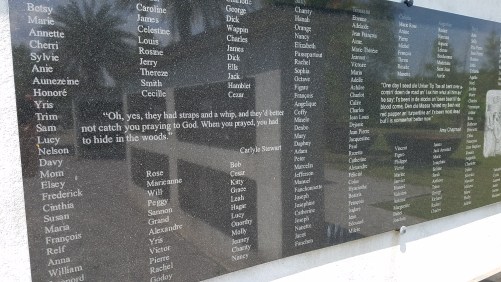
Whitney Plantation Tour, Pics of

Whitney Plantation
Whitney Plantation educates the public about the history and legacies of slavery in the United States. Visitors to the museum will learn about the history of slavery through exhibits, an hour and 15-minute tour, and conversations with our staff.


Booked tour via: Cajun Encounters – Whitney Plantation
Paying homage to slaves of Whitney and across the South. Step back in time and explore the history of this famous plantation.

NOTES – The plantation is about an hour outside of New Orleans. On the way the tour guide gave us some history of the area and we got to see some Louisiana countryside. Highly recommeneded.

Molly Ivins on Picking a Governor

Tough as Bob War and Other Stuff June 7, 1986

We’ve just survived another political season largely unscathed. I voted for Bobby Locke for governor: he’s the one who challenged Col. Muammar el-Qaddafi to hand-to-hand combat. In the Gulf of Sidra. On the Line of Death. At high noon. Next Fourth of July, “Only one of us will come out of the water alive,” said Locke. Locke thinks the trouble with America is that we’ve lost respect for our leaders and this would be a way to restore some. Me too. Besides, you should have seen the other guys.

The Republicans had a congressman running who thinks you get AIDS through your feet. That’s representative Tom Loeffler of Hunt, who is smarter than a box of rocks. His television advertisements proudly claimed, “He’s as tough as bob war” (bob war is what you make fences with), and also that in his youth Loeffler played football with two broken wrists. This cause uncharitable persons to question the man’s good sense, so he explained that he didn’t know his wrists were broken at the time. Loeffler went to San Francisco during the campaign to make a speech. While there, he wore shower caps on his feet while showering lest he get AIDS from the tile in the tub. He later denied that he had spent the entire trip in his hotel room. He said: “I did walk around the hotel. I did see people who do have abnormal tendencies. I’d just as soon not be associated with abnormal people.” If that’s true, what was he doing running for governor of Texas?”

Molly Ivins

The Nation 1865-1990: Selections From the Independent Magazine of Politics and Culture

Jimmy Crack Corn, Blue-Tail Fly – Subtext of

One of the first songs I can remember learning well enough to sing was “Jimmy Cracked Corn” or “The Blue-Tail Fly” (its real name); not for 20 years or so did I realize it wasn’t a nonsense song, a kids’ song, but an expression of glee at a slaveowner’s death. What makes the song chilling is that Massa isn’t made out to be wicked; he isn’t characterized at all, except as Massa—reason enough to crack corn in celebration of his demise. A blue-tail fly got him, as the singer details in a series of verses, each followed by the chorus of merriment (“Jimmy crack corn and I don’t care/ My Massa’s gone away”). We don’t know for sure where he’s gone until the end, when his epitaph is sung. The song was popular in minstrel shows of the 1840s and was handed down for 150 years, transformed into a campfire song for White middle-class kids. Perhaps “A Hard Rain’s Gonna Fall” will be rediscovered In the next century as a cautionary ballad about the need to put on your galoshes.

Faces In The Crowd: Musicians, Writers, Actors, And Filmmakers
Gary Giddins

See also wikiepdia: https://en.wikipedia.org/wiki/Jimmy_Crack_Corn

Lee Surrenders at Appomatox – April 9, 1865

The Battle of Appomattox Court House, fought in Appomattox County, Virginia, on the morning of April 9, 1865, was one of the last battles of the American Civil War (1861–1865). It was the final engagement of Confederate General in Chief, Robert E. Lee, and his Army of Northern Virginia before they surrendered to the Union Army of the Potomac under the Commanding General of the United States Army, Ulysses S. Grant.

Lee, having abandoned the Confederate capital of Richmond, Virginia after the nine-and-a-half-month Siege of Petersburg and Richmond, retreated west, hoping to join his army with the remaining Confederate forces in North Carolina, the Army of Tennessee under Gen. Joseph E. Johnston. Union infantry and cavalry forces under General Philip Sheridan pursued and cut off the Confederates’ retreat at the central Virginia village of Appomattox Court House. Lee launched a last-ditch attack to break through the Union forces to his front, assuming the Union force consisted entirely of lightly armed cavalry. When he realized that the cavalry was now backed up by two corps of federal infantry, he had no choice but to surrender with his further avenue of retreat and escape now cut off as, if he had not, his forces would have been demolished.

https://en.wikipedia.org/wiki/Battle_of_Appomattox_Court_House

To the South, you can rest assured, the day they heard about Appomattox was the way it was for most Northerners about the day they heard of Lincoln’s assassination. It is all over diaries, all over literature. It sometimes is just called “the surrender,” “the day we heard.” There’s so many statements of it, throughout Southern letters and diaries, as I’ve said. I’ll just read a couple, just briefly, and then one from a Northerner, to show you what this moment means on both sides and how difficult reconstruction is going to be — just look at their diaries. Remember Kate Stone? I read from her diary before, a Louisiana planter woman who fled over to Texas and lost most of her slaves. She writes into her diary. “April 28, ‘65: All are fearfully depressed,” she reports. “I cannot bear to hear them talk of defeat.” She still hoped that Confederate armies might rally and fight, as she puts it, “to be free or die.” Easy for her to say. On May 15 she opened a journal entry with this definition, that I may have read before, where the first words are “conquered, submission, subjugation,” she says, “are the words in my heart.” And then when she hears that John Wilkes Booth has shot Lincoln, she rejoiced in Lincoln’s death and honored, at least in her diary, John Wilkes Booth for, quote, “ridding the world of a tyrant. We are glad he is not alive to rejoice in our humiliation and insult us with his jokes.” There are thousands of those expressions in Southern letters and diaries.

That spring and summer an estimated 8 to 10,000 ex-Confederates, many of them former officers, would flee the country. They ended up going to Brazil, England, other parts of Europe, Mexico, Canada, and a few even went as far away as Japan, for fear — I mean, Jubal Early, that conniving old rat — more on him later — he ran to Mexico. He was certain they were all going to be executed, at least the officer corps of Lee’s army — none of them were. And let me read you a diary entry from a Northern woman, a great diarist. Her diary’s hardly known, but man, her diary is almost equal to Mary Chestnut. I first encountered it in a manuscript at the American Antiquarian Society in Worchester. Her name was Caroline Barrett White. She kept a diary for years, decades, and her war-years diary is extraordinary. This is her April 10, 1865 entry. “Hurrah, hurrah, sound the loud timbale over Egypt’s dark sea. Early this morning our ears were greeted with the sound of bells ringing a joyous peal. General Lee had surrendered with his whole army to General Grant!” She’s got exclamation marks all over the place. “Surely this is the Lord’s doing, and it is marvelous in our eyes.” And she goes on and on and on, all kinds of biblical cadences to talk about the sense of jubilation she sees in the streets of her Massachusetts town.

HIST 119: The Civil War and Reconstruction Era, 1845-1877
Lecture 20 – Wartime Reconstruction: Imagining the Aftermath and a Second American Republic

Yale
David Blight